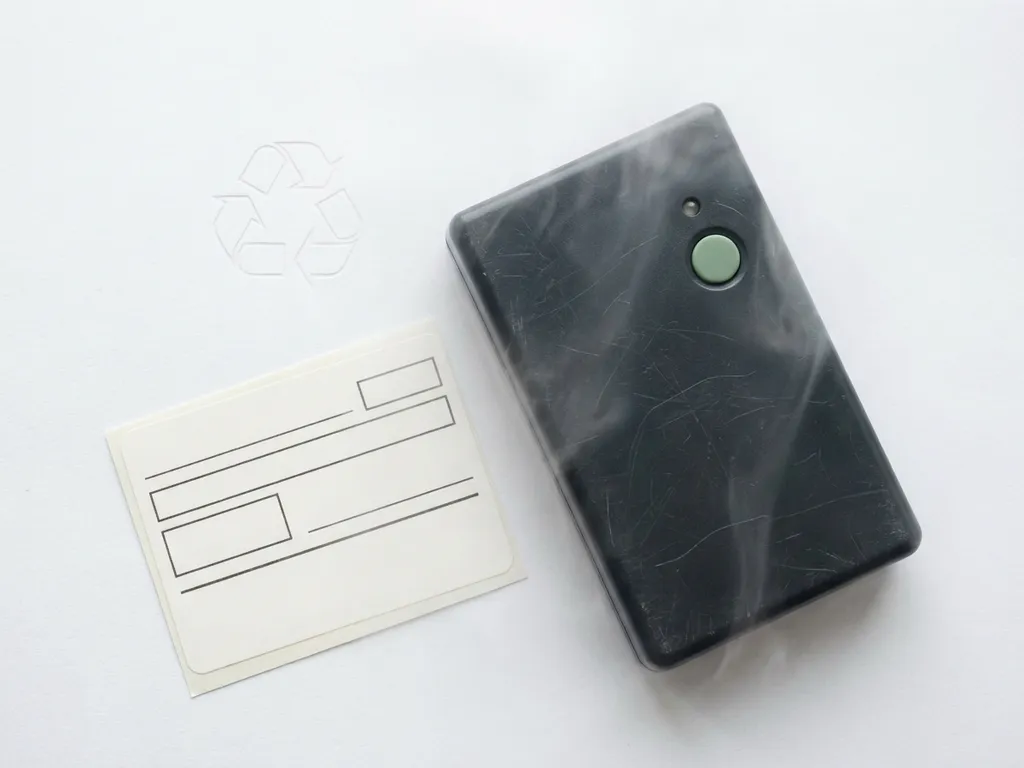
A datalogger recycling programme is an organised scheme in which companies return used electronic temperature dataloggers to the manufacturer or a third-party recycler for proper disposal or component recovery. These programmes exist because electronic dataloggers contain plastics, circuit boards, and lithium batteries that cannot go into standard waste streams. This article unpacks how these programmes work, why traditional loggers are so hard to recycle, and whether a recycling scheme is truly the best solution for your business.
How does a datalogger recycling programme actually work?
A datalogger recycling programme works by collecting used single-use or reusable electronic loggers from customers and routing them through certified e-waste processing facilities. Companies typically register, receive prepaid return packaging, and ship their used devices back to a collection point. The devices are then disassembled, with plastics, circuit boards, and batteries separated and processed according to e-waste regulations.
In practice, the process usually involves several steps:
- Collection: Used loggers accumulate at the receiving end of a shipment, often in warehouses or distribution centres across multiple locations.
- Consolidation: Devices are gathered and packaged for return, sometimes requiring special packaging due to lithium battery transport restrictions.
- Return shipping: Prepaid labels or collection services are used to send devices back to the programme operator.
- Processing: Certified e-waste facilities separate materials. Lithium batteries require specialist handling and cannot simply be shredded.
- Reporting: Some programmes issue certificates of recycling, which companies use as evidence of responsible disposal for internal sustainability reporting.
The operational burden is real. Coordinating returns across international supply chains, managing multiple receiving parties, and tracking which devices have been returned adds meaningful administrative work. For companies shipping thousands of units per year, this can become a significant logistical challenge on top of the core business of moving temperature-sensitive goods.
Why are traditional plastic dataloggers so difficult to recycle?
Traditional plastic dataloggers are difficult to recycle because they are composite products combining multiple incompatible materials: a plastic housing, a printed circuit board, electronic components, and a lithium battery. Each material requires a different recycling process, and the compact, sealed design makes disassembly time-consuming and often uneconomical at scale.
The lithium battery is the biggest obstacle. Lithium cells are classified as hazardous waste in most countries, meaning they cannot enter standard recycling streams. They must be handled by specialist facilities, which are not uniformly available across all the countries where cold chain shipments arrive. A logger shipped from the Netherlands to a warehouse in Southeast Asia or South America may end up in a location where no compliant e-waste facility exists nearby.
The scale of the problem is striking. An estimated 80 million single-use electronic dataloggers are discarded every year across global supply chains. Even where recycling programmes exist, participation rates are limited by the practical difficulty of collecting devices from receiving parties who have little incentive to return them. The result is that the majority of these devices end up in landfill or incineration, contributing to the broader e-waste crisis.
Reusable electronic loggers reduce the frequency of disposal but do not eliminate the problem. After a finite number of charging cycles, rechargeable batteries degrade and the device must eventually be discarded, again as e-waste.
What are the alternatives to a traditional datalogger recycling programme?
The most effective alternative to a datalogger recycling programme is switching to a logger format that does not generate e-waste in the first place. Paper-based dataloggers remove the need for recycling programmes entirely because they use a paper substrate and a lithium-free battery, making them recyclable through standard paper waste streams globally.
Beyond this, companies working with electronic loggers have a few partial alternatives:
- Reusable electronic loggers: Extending the lifespan of each device reduces how often e-waste is generated, but the end-of-life problem remains. The device still contains a lithium battery and circuit board that require specialist disposal.
- Internal collection systems: Some larger organisations build internal processes to consolidate and return used loggers rather than relying on receiving parties to do so. This works within a closed network but breaks down across international, multi-partner supply chains.
- Manufacturer take-back schemes: A small number of datalogger manufacturers offer their own return programmes. These can reduce the administrative burden on the customer but still depend on logistics infrastructure and compliant processing facilities at the destination.
None of these approaches fully solves the core issue: as long as a logger contains lithium and electronic components, its disposal will require more than a standard recycling bin. The battery of paper-based loggers is also worth noting here. Because paper-based loggers use a lithium-free cell specifically engineered for low-power NFC operation rather than a standard lithium coin cell, they avoid the hazardous classification entirely. This means they can be disposed of without specialist handling, which is a meaningful advantage over both single-use and reusable electronic alternatives.
Should your company join a datalogger recycling programme or switch to a sustainable logger?
For most companies shipping temperature-sensitive goods internationally, switching to a sustainable paper-based logger is a more practical and impactful choice than joining a recycling programme. A recycling programme reduces harm at the end of a device’s life but does not change the fundamental problem: electronic dataloggers generate e-waste by design, and recycling programmes depend on participation from receiving parties who may be in different countries, time zones, and regulatory environments.
A recycling programme makes most sense if your supply chain is closed and domestic, your receiving partners are reliable and motivated to return devices, and you have the internal resources to administer the collection and return process. Even then, the programme addresses the symptom rather than the cause.
Switching to a paper-based logger eliminates the recycling question entirely. There is no e-waste to manage, no return logistics to coordinate, and no dependency on receiving parties having access to certified disposal facilities. The environmental benefit is immediate and does not rely on downstream behaviour.
The decision ultimately comes down to infrastructure and intent. If your organisation is serious about reducing its contribution to the global e-waste problem, a recycling programme is a step in the right direction but a limited one. Removing electronic waste from the supply chain at the source is a more complete solution.
How Tapp eliminates the need for a datalogger recycling programme
Tapp has developed the world’s first paper-based datalogger, and as the only provider of this technology, it offers a fundamentally different approach to cold chain monitoring. Rather than managing e-waste after the fact, Tapp’s solution removes the problem at the design stage.
- Lithium-free battery: Tapp’s paper-based loggers use a lithium-free cell, meaning they are not classified as hazardous waste and require no specialist disposal.
- Standard paper recycling: After use, the labels go into ordinary paper waste streams, the same bin used for cardboard and packaging, anywhere in the world.
- No return logistics: Because there is nothing to recover or specially process, receiving parties do not need to return anything. The recycling programme coordination problem disappears entirely.
- NFC smartphone tap: Any NFC-enabled smartphone reads the label instantly, with no app required. Data uploads automatically to the cloud the moment the label is tapped, giving both sender and receiver access to a complete temperature report.
- Up to 90% less e-waste: Compared to traditional plastic loggers, Tapp’s paper-based alternative reduces electronic waste by up to 90%.
If your company is currently running or considering a datalogger recycling programme, it is worth asking whether the effort spent managing that programme could be better directed elsewhere. Tapp’s paper-based loggers make cold chain monitoring simpler, more sustainable, and free from the logistical overhead of e-waste management. Get in touch with Tapp to find out how paper-based monitoring can work for your supply chain.
Frequently Asked Questions
How do paper-based dataloggers actually record temperature data if they don't contain electronic components?
Paper-based dataloggers like Tapp’s use a thin, low-power NFC chip embedded within a paper substrate, along with a lithium-free battery engineered specifically for minimal power consumption. The chip continuously logs temperature readings throughout the shipment journey, just as a traditional electronic logger would. When the recipient taps the label with an NFC-enabled smartphone, the stored data is instantly transmitted to the cloud, providing a full temperature report without any dedicated app or specialist hardware.
What happens if a receiving party in another country doesn't know how to dispose of a paper-based logger correctly?
This is one of the key practical advantages of paper-based loggers: no special instructions are needed. Because they contain no lithium battery and no hazardous components, recipients can simply place them in a standard paper or cardboard recycling bin, the same one used for packaging and boxes. There is no country-specific compliance requirement, no certified facility needed, and no risk of improper disposal, making correct end-of-life handling the default rather than the exception.
We already have a recycling programme in place. Is it worth switching mid-contract, or should we wait until the contract ends?
The answer depends on the administrative and logistical cost your team is currently absorbing to run the programme. If you are managing cross-border return logistics, chasing receiving parties for device returns, or paying for specialist e-waste processing, those costs and inefficiencies are ongoing. Many companies find it worthwhile to run a parallel trial with paper-based loggers on select shipment lanes to compare the operational experience directly before making a full transition decision.
Are paper-based dataloggers accurate and reliable enough for regulated cold chain shipments, such as pharmaceuticals?
Yes. Paper-based dataloggers are designed to meet the same temperature monitoring accuracy requirements as their electronic counterparts, making them suitable for regulated industries including pharmaceuticals, biologics, and food. The temperature data captured and uploaded via NFC can be used for compliance documentation and quality assurance reporting, just as data from traditional loggers would be. It is always advisable to verify that any logger you use meets the specific regulatory standards applicable to your product and shipping lane.
What if our receiving partners don't have NFC-enabled smartphones? Will the data still be accessible?
NFC capability is standard on the vast majority of modern Android and iOS smartphones, so this is rarely a barrier in practice. However, because data uploads automatically to the cloud the moment the label is tapped, senders also have visibility into the temperature report from their end without relying solely on the recipient. If a specific receiving location has older devices, it is worth confirming NFC compatibility in advance, though this is an increasingly uncommon limitation.
How significant is the cost difference between running a recycling programme and switching to paper-based loggers?
The direct cost of a recycling programme includes return shipping, specialist e-waste processing fees, packaging for hazardous transport, and the internal staff time spent coordinating collections across multiple locations. These costs are often underestimated because they are distributed across teams and geographies. Paper-based loggers eliminate all of these downstream costs entirely, and while the per-unit price comparison will vary by supplier and volume, the total cost of ownership picture often shifts meaningfully when programme administration and logistics are factored in.
Can we use paper-based dataloggers for both domestic and international shipments, or are there limitations based on route or product type?
Paper-based dataloggers are designed to work across both domestic and international supply chains, and their disposal simplicity is actually most valuable on international routes where e-waste infrastructure varies significantly between countries. They are suitable for a wide range of temperature-sensitive products including food, beverages, pharmaceuticals, and chemicals. The main variables to assess are the required temperature range, logging duration, and any product-specific regulatory requirements for your particular shipment lanes.


